‘AMR iceberg’ – the underlying social injustices of healthcare
The latest paper from the Fleming Fund Regional Grant team, GEAR up, argues that current action on AMR fails to adequately address the social and political determinants that create vulnerability and the (gendered) power relations sustaining inequity.
The study, published in Nature Communications, uses the ‘tip of an iceberg’ metaphor to illustrate a myriad of underlying issues and complex reasons why diagnostic services and antimicrobial treatment can be inaccessible.
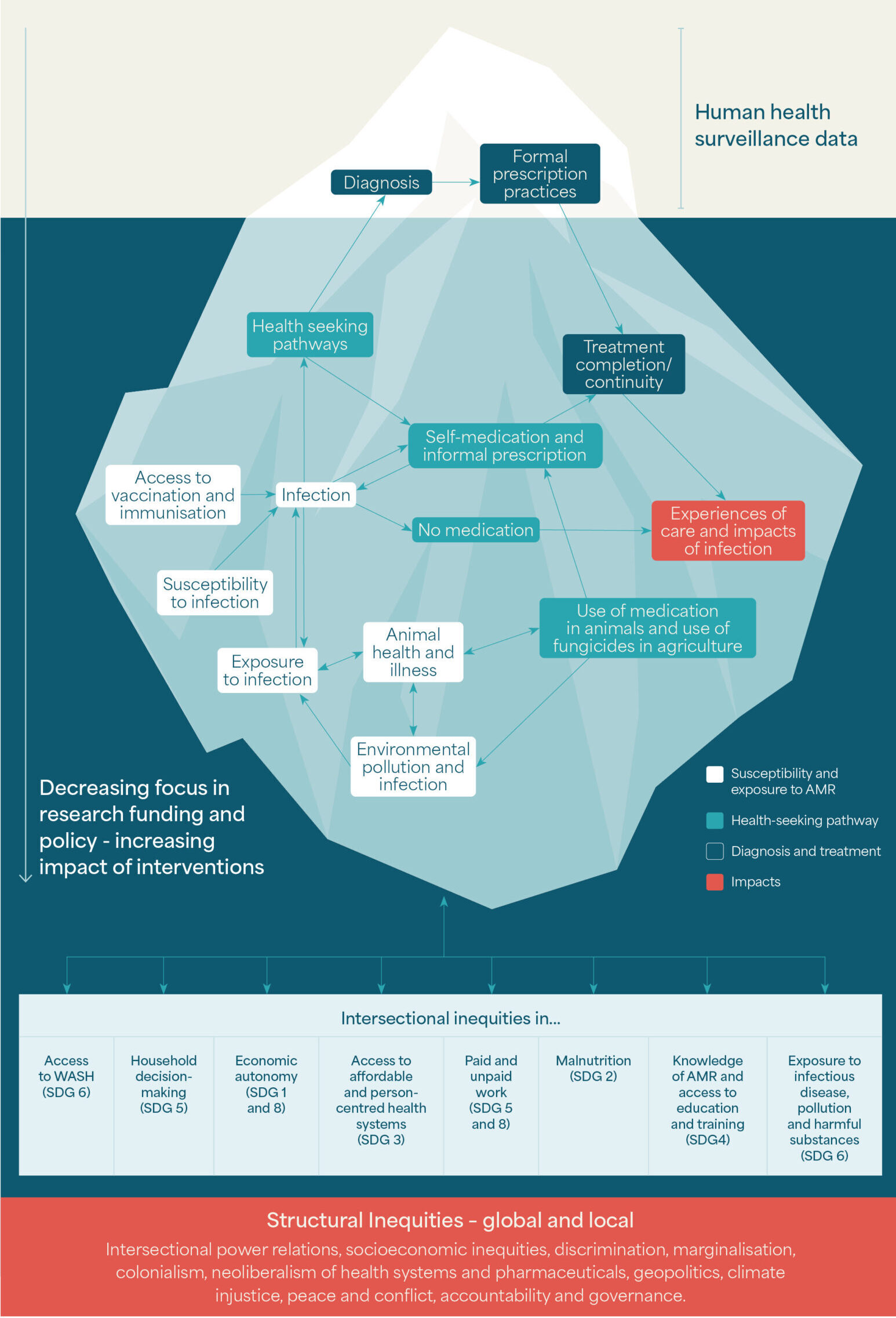
Current research and policy frames AMR as a problem of antibiotic ‘misuse’, proposing solutions such as education and stronger regulation of the sale of antibiotics.
The GEAR up study challenges this approach, recommending a need to:
- Consider AMR as a matter of social justice - the inequitable conditions of living and livelihoods associated with poverty and marginalisation increase the risk of resistant infections and act as barriers to recommended antibiotic use.
- Recognise interconnectedness ─ of humans, the environment and animals and the need for integrated action.
- Improve evidence on how gender roles, responsibilities and relationships contribute to AMR.
- Link country-level structural inequities (including access to health services) to the informal provision of antibiotics.
Creeping disaster
The study explains how AMR is a ‘creeping disaster’ that requires integrated, multisectoral, and cross-border action and can only be addressed at its root. Future research should address concerning evidence gaps related to inequities and injustices, informing access to antimicrobials and influencing the environmental transmission of resistance. These include refugee and humanitarian contexts and living in urban informal settlements.
AMR research requires attention to structural drivers, requires multi-sectoral action and a focus on accountability, particularly for these populations underserved by health systems. AMR interventions must also account for the intersections of human health, animal health and environmental health – exploring the imbalance of environmental and workplace settings and centring the voices of those most affected.
“We are grateful to the Fleming Fund for supporting a global focus on gender and equity in AMR. Through GEAR up, we conducted a systematic global literature review, which sought to unpack the underlying social and structural inequities driving AMR. Our conceptual framework uses the metaphor of an iceberg to highlight the equity biases within surveillance structures, significant gaps in the global evidence base and the missed opportunities to address the structural drivers of AMR.”
Senior author Dr Rosie Steege, GEAR up lead, LSTM.
GEAR up is a Fleming Fund Regional Grant, led by the Liverpool School of Tropical Medicine (LSTM), providing technical assistance and expertise related to mainstreaming Gender and Equity approaches across the Fleming Fund programme.
Listen to lead author Dr Katy Davis discussing the GEAR up paper.
More Like This
Knowledge Notes
From Knowledge Notes, Beyond Bugs and Drugs, an AMR social science opportunity , Date: 11/08/2023
With global Sustainable Development Goals (SDGs) threatened by antimicrobial resistance (AMR), how can social science play a critical role in finding solutions?
Programme Update
From Programme Update, Putting Gender and Equity at the heart of the Fleming Fund's next phase , Date: 24/03/2023
There is a growing recognition that both sex (the physical dimension) and gender (the psychosocial dimension) – and the interaction between them and behaviours between them – can play a significant role in antimicrobial resistance (AMR) and use (AMU).