Paper to practice: Fleming Fellows shaping health policy in West Africa
Tackling antimicrobial resistance (AMR) demands a diverse workforce, spanning a range of disciplines from microbiology to data analysis. The Fleming Fund Fellowship Scheme addresses this need by equipping frontline professionals with the skills to empower their response to the ever-present challenge of AMR.
The complex, systemic nature of AMR requires the development of networks, adept navigation of political systems, and the ability to communicate evidence effectively to drive health policy reform.
We spoke to three alumni fellows from West Africa exploring their paths into leadership positions, and how the skills gained during fellowships are enabling them to shape AMR policy and influence healthcare regulations in their respective countries.
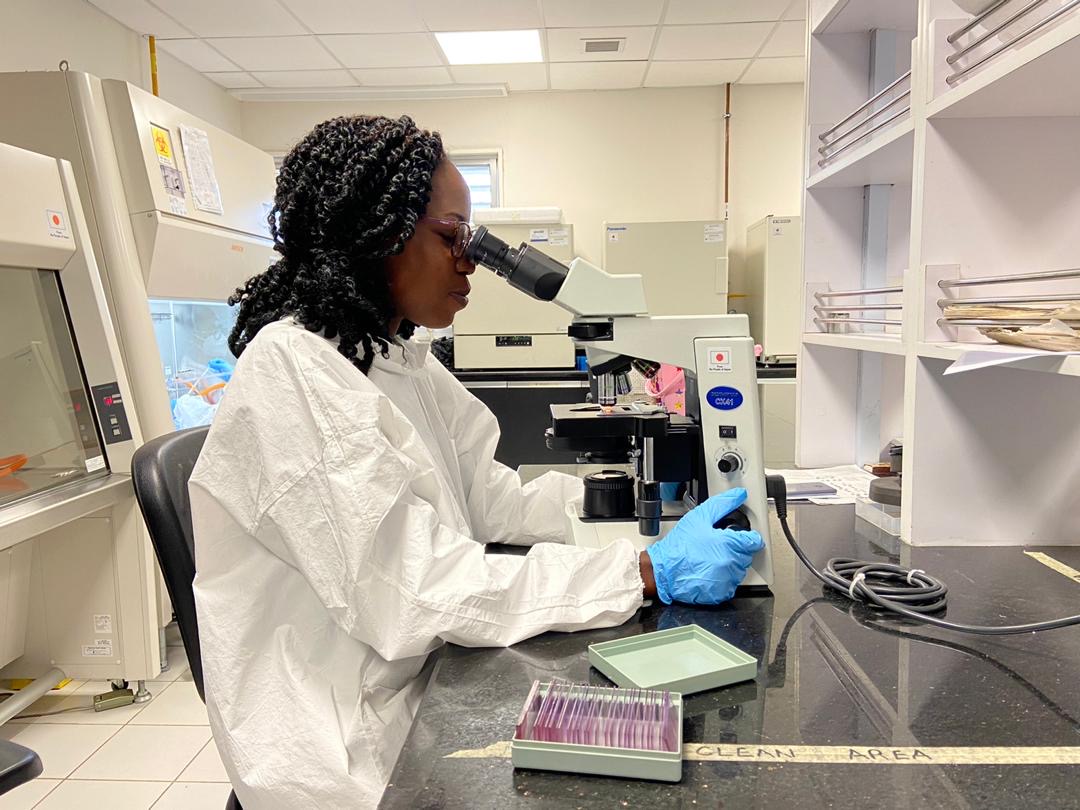
Above shows: Fleming Fellow, Dr Esther Dsani at the bacteriology laboratory at the Noguchi Memorial Institute for Medical Research, University of Ghana.
Over 370 health professionals and policymakers have participated in the Fleming Fund Fellowship Scheme since 2018. These fellows are embedded within national public health institutions, including reference laboratories, hospitals, ministries and surveillance sites, where they apply new AMR skills into practice in their daily work. By sharing their knowledge and experiences with colleagues, they contribute to strengthening overall workforce expertise.
In each country, fellows form a cohort specialising in disciplines including human and animal health, aquaculture, microbiology, surveillance, bioinformatics, and clinical practice. This structure enables peer-to-peer learning and facilitates One Health collaboration. In parallel, each fellow collaborates with a mentor to design a tailored professional development plan, where the mentor provides targeted training and support to contribute to national AMR policies, strategies, and guidelines.
In Ghana and Nigeria, priority West African countries for the Fleming Fund, several fellows have transitioned into leading and policymaking roles and are advancing urgent action on AMR.
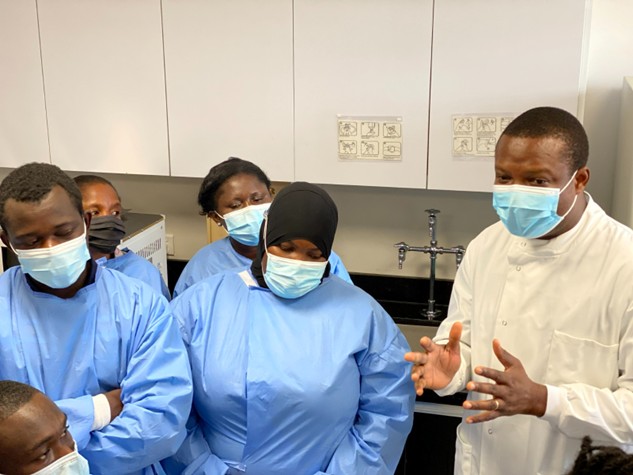
Fleming Fellow, Nicholas T.K.D. Dayie, training laboratory personnel on bacteria identification and Antimicrobial Susceptibility Testing at the Noguchi Memorial Institute For Medical Research, Ghana.
Career turning point
Nicholas T.K.D. Dayie ─ Professor of Medical Microbiology at the University of Ghana Medical School and the International Programmes Coordinator for its College of Health Sciences ─ completed a Laboratory Fleming Fellowship in 2020 on AMR in human health, mentored by the London School of Hygiene and Tropical Medicine.
Since completing his Fellowship, he has assumed multiple consulting and technical leadership roles to develop national strategies and guidelines, including Ghana's Integrated Antimicrobial Resistance, Use and Consumption Surveillance Strategy. Nicholas emphasises that the Fellowship was pivotal in his transformation from a laboratory-based scientist to a systems-oriented leader in AMR.
“My mentor’s confidence in my potential, coupled with consistent guidance and high professional standards, sharpened my focus, strengthened my leadership capacity, and inspired me to pursue impact beyond the laboratory,” said Prof Dayie. “This level of mentorship and exposure was instrumental in my professional growth and ultimately, my promotion to Professor.”
One of the greatest privileges [...] has been witnessing fellows realise the power of their own voice [...]; leadership and passion that ultimately move national AMR strategies from paper to practice.”
Elinam Segbefia, Fleming Fund Fellowship Scheme Manager, West Africa.
Technical leadership
In Nigeria, Mwapu Ndahi ─ the National Focal Point for AMR in the animal health sector and a member of the national AMR Coordinating Committee and the One Health Technical Working Group ─ completed a Surveillance Fleming Fellowship in 2021 on antimicrobial use (AMU) in the animal health sector, mentored by the Technical University of Denmark (DTU).
Mwapu has since advocated for policies banning antimicrobials as growth promoters in the animal health sector. This has involved championing international collaboration through an AMR project delivered by Nigeria and Denmark’s Sector Strategic Cooperation, which aims to strengthen biosecurity and promote the prudent use of antimicrobials in poultry farming.
“The training from my Fleming Fellowship on AMR and AMU surveillance gave me the knowledge to translate data into policy and built my confidence in stepping into the leadership role of national AMR Focal Point for animal health and, ultimately, to director-level in the Nigerian Federal Civil Service,” said Mwapu.
Dr Esther Dsani, also from Ghana, completed a Bioinformatics Fellowship on AMR in animal health in 2023, mentored by DTU. Now, she coordinates AMR projects across Africa, providing strategic and technical leadership to support countries implementing field interventions, with a focus on animal health and food systems.
"The Fleming Fellowship was a turning point in my career," says Dr Dsani. "It enhanced my ability to translate complex genomic and laboratory data into insights for decision-makers and bridge knowledge-translation gaps in the animal health sector in Ghana."
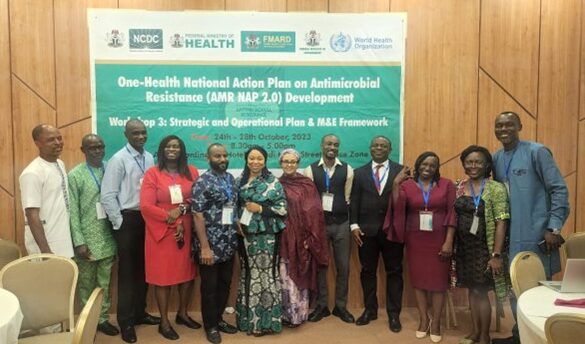
Fleming Fellow, Mwapu Ndahi (third, right), with planning committee members of National Action Plan 2.0 for Nigeria.
Confidence, communication, and connections
As well as strengthening expertise in microbiology, surveillance and bioinformatics, the Fellowship Scheme provides space for fellows to exercise critical leadership and communication skills.
Prof Dayie reflects that, “the Fleming Fellowship Scheme positioned me to translate technical expertise into leadership, influence policy development, and drive coordinated national action on AMR control.” Dr Dsani similarly comments that she became more confident in leading high-level technical discussions through her Fellowship, making her more effective at engaging different AMR stakeholders.
Beyond training and mentorship, the Fellowship Scheme encourages ongoing learning through networks and regular events. For Mwapu, the monthly webinar series proved invaluable, offering opportunities to learn from other fellows and mentors and apply those insights in her everyday work in the AMR animal health sector.
Elinam Segbefia, who has been the Fellowship Scheme Manager for West Africa since 2019, says: “One of the greatest privileges of my role has been witnessing fellows realise the power of their own voice. They start on lab work or surveillance tasks and by the end, they are confidently contributing to and defining national AMR discourse.” He adds that it is the fellows’ “leadership and passion that ultimately move national AMR strategies from paper to practice.”
Sustainable investment for AMR action
Drawing from their experiences during the Fleming Fellowships, Prof Dayie, Dr Dsani, and Mwapu offer guidance to aspiring AMR professionals and policymakers, learnt from their Fleming fellowships.
Esther encourages emerging professionals to build interdisciplinary skills and seek continuous learning opportunities, pinpointing the importance of acknowledging AMR as a core One Health issue. Mwapu advised joining a Community of Practice and sharing experiences to drive progress on AMR at both national and international levels. Echoing these themes, Prof Dayie emphasises the importance of interdisciplinary training and sustained global connections, adding: "sustainable AMR action depends on locally grounded leaders who can connect global knowledge with national realities."
As national and global efforts to address AMR gain momentum, professionals who combine technical expertise and political fluency will be critical in translating evidence and data into effective policies. “This includes advocating for how limited resources are allocated across health systems to deliver the greatest impact,” said Elinam. “The trajectory of these fellows offers a clear lesson: their success is a reminder that people are the most sustainable investment for AMR response.”
More Like This
Studies & Reports
From Studies & Reports, GRAM paper launch event highlights need for decisive action on AMR , Date: 09/10/2024
The GRAM project led by Institute for Health Metrics and Evaluation and the University of Oxford and funded by the UK Department of Health and Social Care’s Fleming Fund and Wellcome, released the latest GRAM paper, published in *The Lancet*.
Studies & Reports
From Studies & Reports, Turning Plans into Action - Working Paper by World Health Organization , Date: 31/03/2019
Turning plans into action, a working paper from the World Health Organization on implementing National Action Plans on antimicrobial resistance (AMR).